

The Beautiful Ones
On optimization, withdrawal, and the cost of a frictionless life

Remember that moment in Big when twelve-year-old Josh stands in front of Zoltar, the carnival fortune-telling machine, and makes a wish?
He’s just been told he’s too short to ride. And the girl he’s trying to impress drifts toward a taller, older boy. In that painful moment, he doesn’t wish for confidence or character.
He wishes to be “big.”
By morning, the wish is granted.
He wakes up in a grown man’s body and the world rearranges itself around him. Adults take him seriously. Doors open. He has an apartment, a job, money in his pocket. He didn’t really earn any of it, but there it is — size without growth, status without the awkward years in between.
Have you ever wanted that?
Not necessarily to be bigger. But to wake up on the other side of struggle. To bypass the uncertain, friction-filled middle.
Now, imagine you’re standing in front of Zoltar. You’re tired. Worn down by how complicated everything feels right now. Relationships. Work. Money. Your aging body. The future.
The machine hums. The lights flicker. You get one wish.
What is your wish?
Make life easier.
Imagine it.
The house is paid for. You’re insulated from market swings. Inflation is something other people bitch about. The refrigerator is full. Your body is free of weird aches. Your hormones are balanced. And that extra fifteen pounds? Gone, permanently.
You don’t answer to a boss. Dating is effortless — the right person appears, already vetted, aligned, certain. You’re safe. Fed. Desired. No scarcity. No rejection. No struggle.
Paradise.
If offered this life, you would at least consider it, right?
The desire to remove life’s friction isn’t a moral failure. It’s human instinct. Water runs downhill. We lean toward ease. And if someone told you they had built such a world — abundant, climate-controlled, medically supported, free of threat — you would assume its inhabitants would flourish.
Why wouldn’t they?
universe 25
In 1968, behavioral scientist John B. Calhoun built that world for mice. He called it Universe 25.
The enclosure was spacious and temperature regulated. Food and water were unlimited. There were no predators. Illness was treated. Nesting boxes were thoughtfully designed. Every practical threat to survival had been removed.
It was nirvana for rodents.
At first, it worked exactly as you’d expect. The colony multiplied. Litters were born in rapid succession. The population surged. It appeared to confirm what we believe: abundance produces prosperity.
But then, as the mice proliferated, the social order shifted.
Males began to fight in erratic bursts of aggression. Mothers abandoned or attacked their pups. Mating patterns deteriorated. Hierarchies dissolved. Some mice became hyper-violent; others withdrew entirely.
Among the withdrawn, Calhoun identified a group he called “the beautiful ones.”
These mice not only stopped competing and mating — they opted out of society entirely. They spent their days eating, sleeping, and grooming themselves. Their coats were immaculate. Because they no longer fought for territory or mates, they bore no scars.
They lived longer and looked healthier. But they were incapable of intimacy.
Birth rates fell. The population aged. And despite unlimited resources, the colony collapsed.
In a perfectly engineered world where survival was guaranteed, participation dissolved.
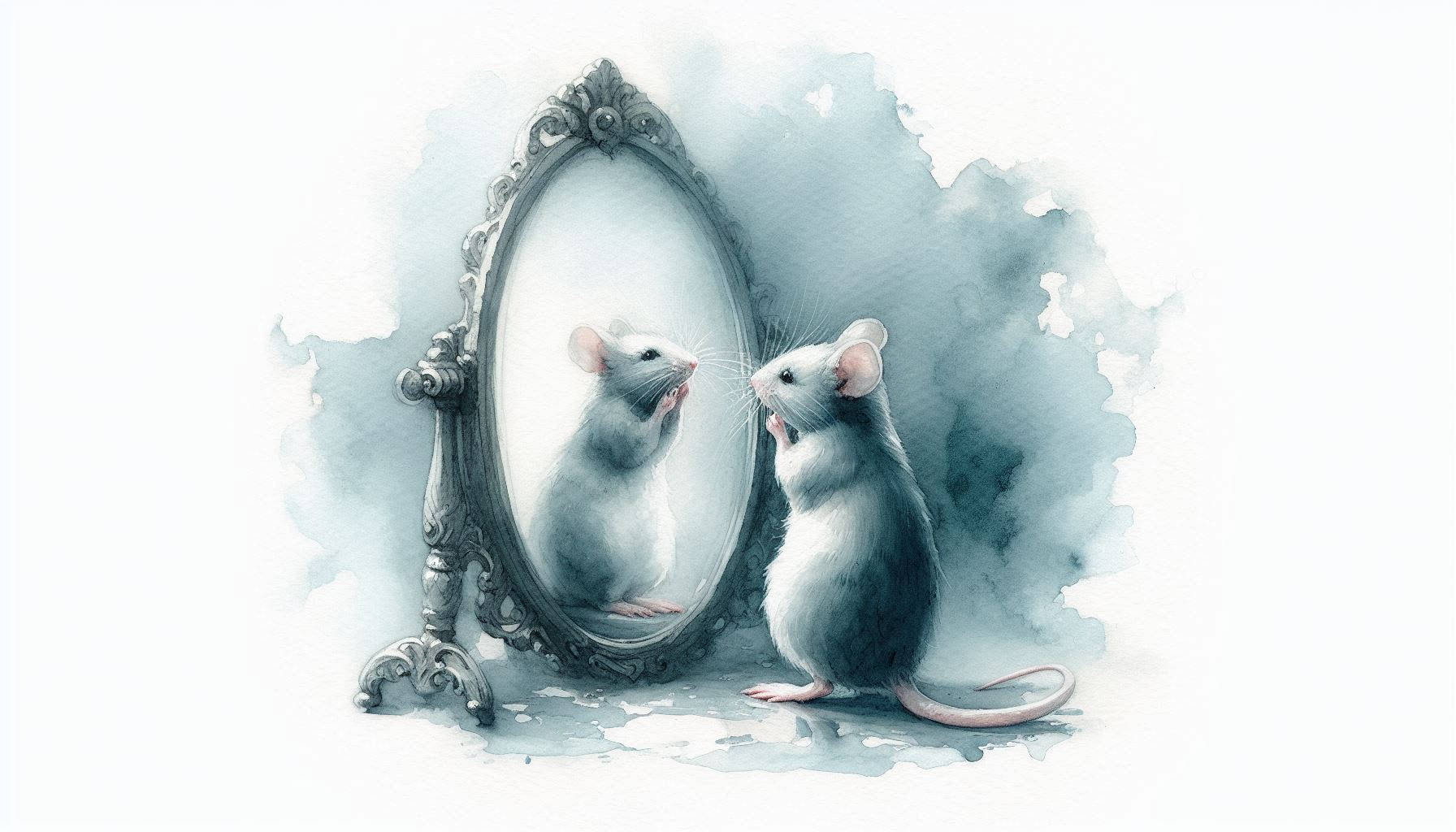
I learned about this little mouse utopia and haven’t been able to shake how adjacent it feels to our current moment. And the longer I’ve sat with it, the more uncomfortable the recognition has become — because when I first read Calhoun’s study, I interpreted it as a story about men. About forums and screens and the slow retreat of a certain kind of male sociality into optimization and performance.
And it is that.
But it is also, if we are being fully honest with ourselves, about us.
the beautiful ones are everywhere
Take dating.
Among the women I know navigating midlife dating, a familiar pattern emerges: endless messaging that rarely converts into an actual meeting. Plans made and canceled hours before. Conversations that burn brightly for days and then evaporate.
We have embraced a digital system that offers unprecedented access while removing much of the awkwardness that once defined courtship. No need to walk across a room and risk rejection in front of friends. No fumbling through small talk at a party. Instead, we scroll, filter, and pre-screen thousands of faces sortable by height, politics, religion, hobbies, income.
The friction that once required courage has been redesigned into convenience.
Theoretically, this should make connection easier. And yet real intimacy feels more fragile than ever.
When rejection can be avoided with a swipe, it can also be endlessly deferred. Men withdraw into screens and self-optimize — or they become aggressive and lash out. Women grow more self-sufficient and more guarded. We are all doing our grooming, in our own ways, with our immaculate coats — wondering why the room feels so empty.
Of course, women have long inhabited this particular fun house. The scrutiny around appearance is not diminishing — it is intensifying, and it has migrated inward.
There’s a WhatsApp thread I’m part of where the information flows constantly: peptides, GLP-1s, lasers, fillers, lymphatic drainage, vampire facials, face brushing, hair growth, lash extensions, biohacking protocols, Mexican med spas. Every insecurity named. Every remedy priced to what the market can bear. The same single mom who vents about how expensive it is to take her two kids out for tacos can plan a $20,000 aesthetic “refresh” without irony.
Men are doing it too, in their own register. Entire forums dedicated to looksmaxxing — young men dissecting their faces with architectural precision, ranking jaw angles and eye spacing on numerical scales. Boys as young as thirteen uploading photos to AI tools for attractiveness scores before they’ve grown into their bodies. Like the beautiful ones, they have stopped competing in the old ways. Instead they groom, optimize, and retreat into self-measurement — immaculate on the outside, increasingly isolated within.
I’m not immune. I tell myself I refuse to hand over my earnings to an industry that seeds and exploits women’s insecurities. And yet I have paid to smooth the wrinkles in my forehead. I have tried the creams and the shots and the pills. That’s in addition to the books, the courses, the programs — the entire parallel economy built around optimizing the mental, emotional, relational, and spiritual aspects of self.
At what point do these efforts to maintain wellbeing veer into something else entirely?
It would be easy to dismiss this as vanity. But that explanation is too shallow.
If we dig beneath the surface of these tendencies, what we find is not simply a desire to look better. It is a desire to anchor ourselves in a world that is becoming increasingly unstable. When dating is gamified and financial security is elusive, the self — particularly the body — offers the illusion of control. It is measurable, adjustable, responsive. It feels like the one domain that still answers effort with results.
life is itchy
There is a concept in Buddhist philosophy called dukkha — usually translated as “suffering.” Perhaps a better way to understand it is unsatisfactoriness. The persistent, low-grade friction of being alive in a body that ages, in a world that resists, among people who disappoint and surprise us.
The First Noble Truth is that life, at its most ordinary, contains a kind of structural itchiness. And for most of human history, we met that truth head-on. Friction was the texture of existence, not evidence of a system that hadn’t been optimized yet.
What we are doing now is something new. Instead of accepting this friction as a fact of life, we are engineering the gap closed through the modern work of optimization. And it is, measurably, working. We are less physically uncomfortable than any humans in history. By nearly every material metric, we have won.
And yet. Here we are.
the ladder, and the missing rungs
Work is shifting beneath our feet as well.
For generations, it functioned as a primary site of identity formation — a ladder along which adulthood unfolded. You started at the bottom. Learned by observing and doing. You made mistakes, absorbed corrections, developed competence. The ladder was imperfect, often unfair, but it existed.
Now the lower rungs are disappearing. Entry-level roles in writing, research, analysis, design, support, and more are being automated. The advice is to manage the systems rather than develop the craft. The ladder didn’t just get harder to climb. Someone removed the bottom rungs and told us this would be easier.
I feel this in my own work. Tasks that once required hours of craft can now be completed instantly. Even as I lean into it, I feel the destabilization. I question where, exactly, my value lives.
If the early contribution vanishes, where do young adults begin? Where do they experience the friction that builds character?
I joke about retreating to five acres, keeping bees, and baking bread. It’s my fantasy version of social withdrawal in response to anxiety and overwhelm. I’m 49. Reinvention is a choice for me.
But what about the 22-year-old stepping into adulthood?
What replaces initiation when the hierarchical climb is inaccessible? Connection requires risk. Competence requires apprenticeship. Meaning requires resistance. What happens when we engineer all three away?
the purpose of difficulty
There is a theologian named Barbara Brown Taylor who argues that we have catastrophically overemphasized light. We call goodness light. We call growth illumination. We call revelation enlightenment. And in doing so, she says, we have pathologized the dark — the difficult, the uncertain, the painful — when in fact the dark is precisely where the most important things happen. Seeds germinate in darkness. Eyes adjust in darkness. The hardest truths are the ones we arrive at only when the familiar landmarks disappear.
I think about this when I think about what we are doing with difficulty.
We have decided, culturally, that difficulty is a design flaw. That discomfort is a problem requiring a product. And so we have built, with enormous ingenuity and almost no philosophical reflection, an entire infrastructure of comfort — and we are discovering, the way every generation discovers the consequences of its deepest assumptions, that the infrastructure does not produce what we thought it would.
There’s a story I love about a boy who found a butterfly cocoon and brought it home. He sat for hours watching the insect struggle to emerge. It had managed to create a narrow opening, but its body appeared too large to pass through. It pushed and strained, and then eventually, it grew still.
The boy was concerned, so he intervened. He took a pair of scissors and widened the opening so the butterfly could slip out easily.
When it did, its body was swollen and weak. Its wings were crumpled and limp. The boy waited for it to take flight, but it never did.
What he failed to understand was that the pressure of that narrow passage forces fluid from the butterfly’s body into the wings. Without that compression, without that friction, the wings do not form.
In relieving what looked like unnecessary suffering, the boy arrested development.
The cocoon is not cruelty. The cocoon is the making.
So much of what we’re calling progress is an attempt to widen the opening. To smooth the path. To eliminate friction.
Dating without rejection. Work without apprenticeship. Beauty without aging. Income without labor.
We see friction and assume it is a design flaw.
Sometimes it is the design.
This is not an argument for glorifying hardship. Medicine and safety are miraculous achievements. But there is a difference between easing suffering and removing the forces that shape us.
behavioral sink
The mice in Universe 25 did not collapse for lack of resources. They collapsed because the structure of a meaningful life dissolved.
Calhoun called it “behavioral sink” — the point at which, stripped of challenge and consequence, creatures stop doing the things that constitute a life: seeking, risking, building, belonging. The beautiful ones ate. They groomed. They were physically pristine and socially absent. They had optimized themselves out of participation.
I keep looking at our own behavioral sink.
The apps that remove the risk of approach and produce instead an endless scroll of faces that feel less real the more of them we see. The forums where young men rank their bone structure rather than test their character. The work that no longer requires the grind through which you discover what you’re actually made of. The AI that completes the sentence before you’ve had to struggle toward it yourself.
And beneath all of it, a spreading loneliness so ordinary we’ve stopped calling it a crisis.
Midlife is a particular crucible for this dynamic. Because midlife — real midlife, not the curated Instagram version — involves a series of unmerciful reckonings. The body begins to assert itself in ways that cannot be optimized away entirely. The face changes. The metabolism shifts. The hormones that once organized our emotional and erotic lives go through a kind of controlled demolition. Children grow up and need us differently, or not at all. Marriages reveal their architecture — what has been holding them and what has always been missing. Careers plateau, or pivot, or simply reveal themselves as insufficient containers for everything we are.
This is the moment — genuinely, structurally — when the mirror becomes most tempting.
The beautiful ones weren’t suffering. That’s what makes them so hard to read as a warning.
We are not mice. But the temptation is the same — to widen every cocoon, to smooth every passage, to relieve what looks like unnecessary suffering.
The wings fill because of pressure.
Remove it entirely and we may find ourselves polished, optimized, and safe — but standing at the glass, unable to fly.
So let me ask again:
What is your one wish?
Love,
~ Linzi